
Recommending Toxicity: Lecture Reflection
By Alayna Brandolini
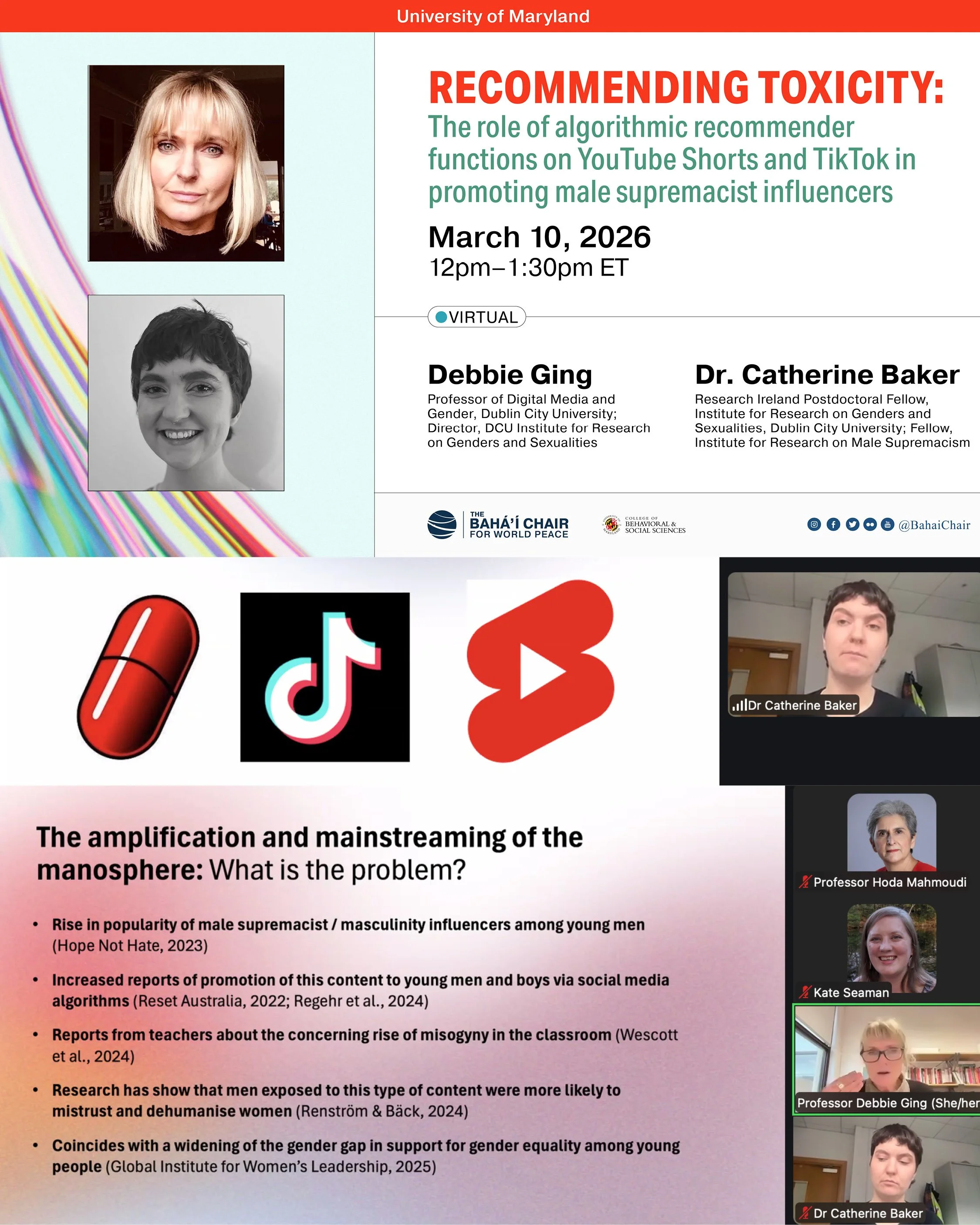
On March 10th, the Bahá’í Chair for World Peace at the University of Maryland hosted a virtual distinguished speaker lecture titled Recommending Toxicity: The role of algorithmic recommender functions on YouTube Shorts and TikTok in promoting male supremacist influencers. Professor Debbie Ging and Dr. Catherine Baker from the Institute for Research on Genders and Sexualities (IRGS) at Dublin City University presented their research on the topic.
The content that young people consume plays a significant role in shaping their belief system and the way they view themselves and others. The growing prevalence of male supremacist influencers on social media poses a challenge to peace as it impacts younger generations’ ideologies regarding gender roles, dominance, and intimacy. Understanding the role that social media algorithms play in promoting male supremacist, anti-feminist content is key to addressing the growing issue of misogyny amongst Generation Z.
The four trends that Professor Ging and Dr. Baker identified within the manosphere – an ecosystem of male rights groups – are migration, diversification, commercialization, and monetization. This ecosystem of misogyny originated in online message boards such as 4Chan and Reddit, but over the past decade has migrated to social media platforms such as TikTok and YouTube Shorts. Since then, the phenomenon has grown and even diversified, with groups like the “Black manfluencers” and “tradwives” gaining popularity. The shift to social media also allowed this ideology to be commercialized and monetized, with male-rights influencers (or manfluencers) profiting from viewership and engagement with their content and services.
Professor Ging and Dr. Baker conducted a study in which they created ten fake TikTok and YouTube Shorts accounts:
Two 16-year-old boys who demonstrated engagement with traditionally masculine content, such as sports, gym videos, comedy, and video games.
Two 16-year-old boys who sought out typical manosphere content, including Andrew Tate, “feminist owned” compilations, etc.
Two 18-year-old boys who demonstrated engagement with traditionally masculine content, such as sports, gym videos, comedy, and video games
Two 18-year-old boys who sought out typical manosphere content, including Andrew Tate, “feminist owned” compilations, etc.
And finally, two blank control accounts that demonstrated no particular interest in any type of content.
What they found was that the algorithms recommended male supremacist, anti-woman content to all of the male experimental accounts within 23 minutes of scrolling the app, with the earliest exposure coming just two minutes in. 61.5% of the content recommended on YouTube Shorts and 34.7% of the content recommended on TikTok was manosphere or far-right adjacent. Dominant narratives of this content included hypermasculinity, misogyny, anti-feminism, anti-LGBT, conspiracies, anti-education, and rigid body ideal-based content.
These findings are incredibly concerning. Gen-Z boys and men are the first generation to be more conservative and value gender equality less than the men of older generations. Experts at the Global Institute for Women’s Leadership have observed a widening of the gender gap in support for gender equality among young people, and many schoolteachers have reported a concerning rise of misogyny in the classroom.
Professor Ging and Dr. Baker presented various recommendations for social media executives, school systems, and politicians to avoid promoting harmful content. Some key recommendations include improving diversity within algorithm-creating teams, establishing better critical media literacy programs in schools, and publishing algorithmic data for further research and accountability.
This crisis among young boys is reflective of a greater culture war brought on by times of economic and political insecurity. Harmful manosphere content often fills a void of connection, community, and peer acceptance for young people and distracts them from the frightening reality of the world. It provides an outlet for frustration and anger within their personal lives or about the state of the world around them.
Throughout the lecture, I found myself asking, “What can be done about this?” Social media is capable of influencing people's values, attitudes, and actions, and it is frightening to see such dangerous content circulated and amplified by algorithms.
An interesting form of resistance was brought up during the Q&A session. Manosphere content typically disguises itself as self-help or motivational content to draw in a wider audience. Once a person engages with that content, more openly misogynistic videos may be suggested to them. A young boy may seek advice and inspiration from popular male influencers only to be indoctrinated into the manosphere and exposed to harmful ideologies that they are inherently susceptible to due to their young age and need for belonging.
It is clear that young boys are seeking connection, belonging, and validation, and they are getting those needs met in the manosphere. However, this need could be better addressed by positive male influencers sharing genuine advice instead of promoting violence, dominance, and emotional repression. The speakers mentioned that, in recent years, there has been a trend of feminist male influencers gaining momentum on these short-form video platforms. I view this as great progress towards curbing misogyny in the younger generation, and I hope that these feminist male influencers continue to offset the harmful ideologies pushed by the toxic manosphere.
It is imperative that researchers like Professor Ging and Dr. Baker continue to study this trend and work with policymakers to find solutions to the frightening trend of online misogyny among Gen-Z boys.