
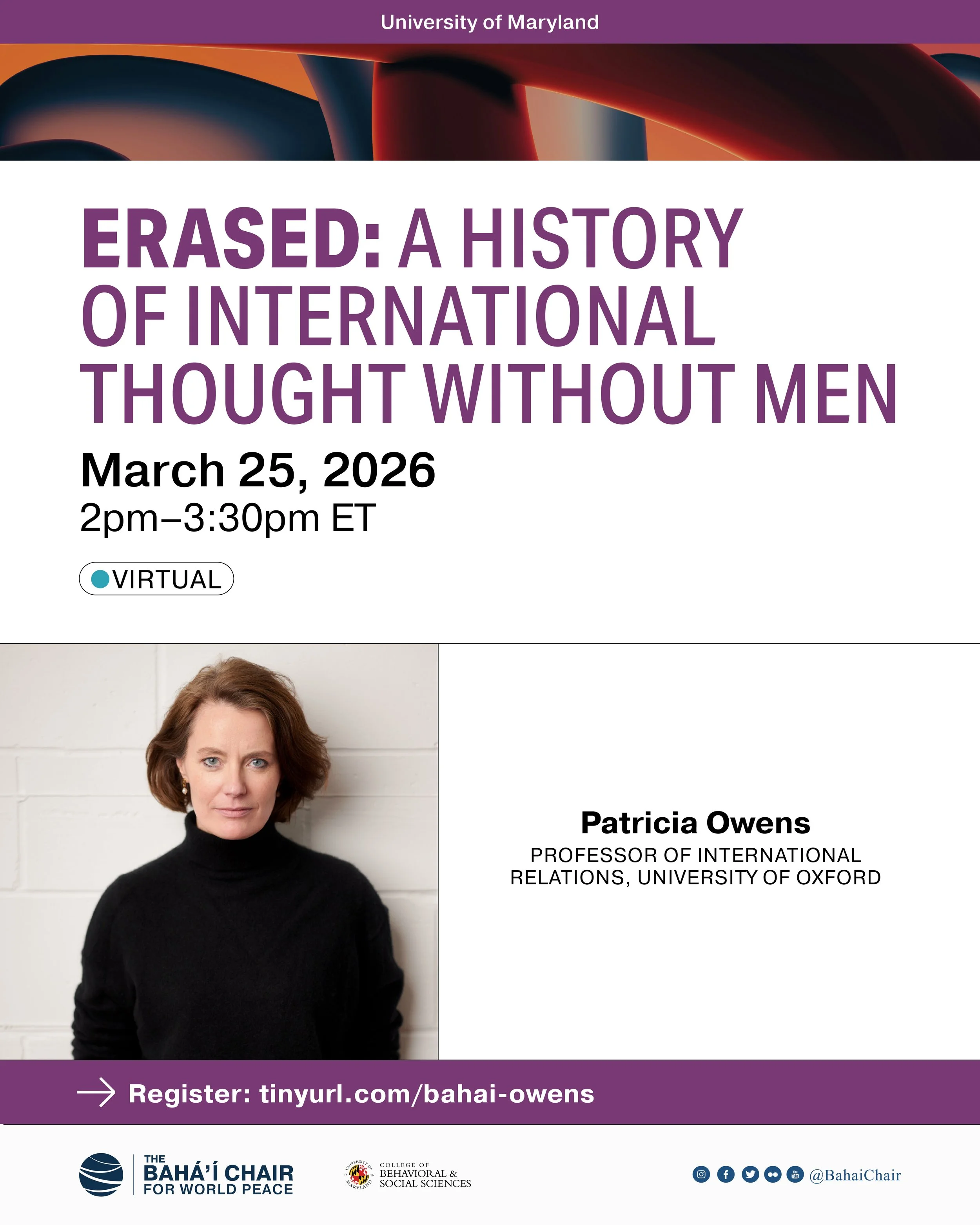
Author and Oxford Professor Patricia Owens discussed her most recent book, Erased: A History of International Thought Without Men, during a virtual event hosted by the Bahá’í Chair for World Peace at the University of Maryland on March 25th.
The book tells the stories of women such as Merze Tate, the first Black woman to attend the University of Oxford, Margery Perham, an influential advocate for British decolonization, and Susan Strange, one of the most well-known female political intellectuals.
Erased: A History of International Thought Without Men argues that women’s intellectual labor was essential to the founding of the new cross-disciplinary field of international relations in the early twentieth century. Still, these female academics were discriminated against and their ideas devalued, eventually being erased from the record altogether.
As an international relations student, I found this lecture thought-provoking. Dr. Owens’ research demonstrated that, behind many of the founding IR scholars I have studied in school, were women’s ideas, research, and theory.
Similar patterns have been uncovered across various disciplines: for centuries, men have taken credit for women’s work in engineering, biology, art, literature, and so on. However, Dr. Owens stressed the unique situation within the field of international relations because women were essential to the very founding of this relatively novel discipline.
Although many of these female IR scholars received little recognition during their lifetimes, I think it is important to honor their legacies by educating students on the impact that these women had on the field of international relations. Even today, international relations is a male-dominated field, with the majority of IR researchers, professors, and foreign service officers being white men.
I feel that, by acknowledging the role that women played in founding the discipline of international relations, the IR community can encourage the next generation of women to pursue a career in this field. Books such as Erased: A History of International Thought Without Men are incredibly important in advancing equity in international relations and inspiring future IR scholars.
By Alayna Brandolini