
Coming Up March 10: Recommending Toxicity
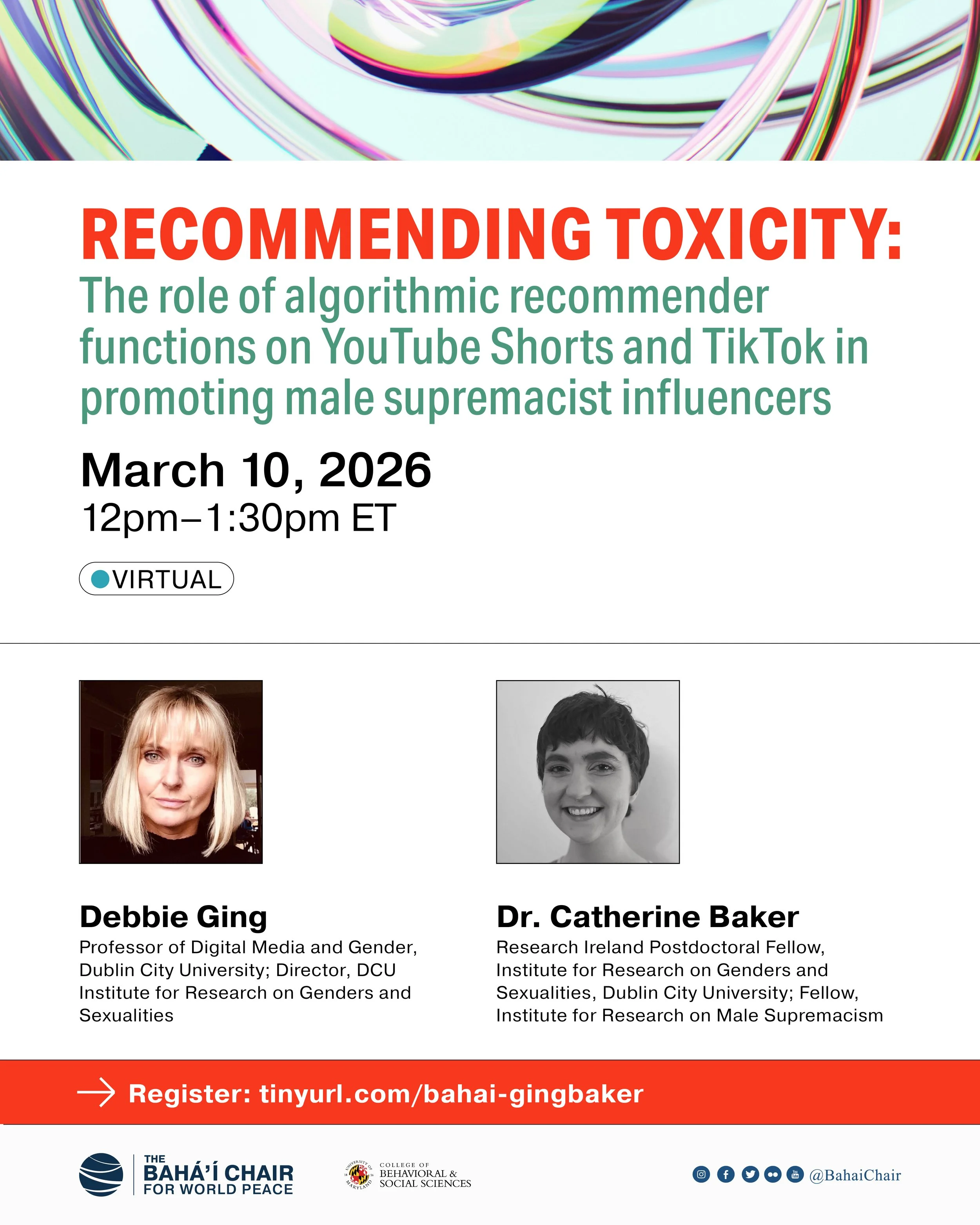
On March 10th the Chair will host “Recommending Toxicity”, by Dr. Debbie Ging and Dr. Catherine Baker. Both scholars examine how social media companies like TikTok and YouTube help spread male-supremacist ideas.
It is difficult to underestimate the importance of this issue, not only in America but throughout the world. For the data shows, nearly uniformly, that something is happening, particularly with young men, and especially within Westernized countries. There is a hardening off, a sectioning away, and a dividing – even at times a disappearance – of certain notions of masculinity. These notions – some new, some older retreads, are having a powerful impact on young men during their formative years. We see the resultant split in politics, in social norms, in ideas of sexuality and sociability – truly, in a million little ways. It does indeed seem that whole swaths of society are changing all at once.
We see signs of it in the global South and the North, among the wealthy and working classes, and across previously well-scripted racial definitions. We see it in ‘surprising’ electoral results in countries like France, Poland, and the Philippines. We see it in the data behind the most recent American presidential election as well. Though there is disagreement about what is causing these changes, or the ways such changes are being distributed, it is becoming increasingly clear that something is happening.
And while scholars and laypeople may have differing views for how to address this, we do seem to know what is not helpful: castigating, shunning, mocking, disparaging. And, I would argue, presenting off-the-cuff, sofa analysis without hard data.
“Recommending Toxicity” continues the Chair’s legacy of addressing the great challenges of our time in thoughtful, considered, and data-based ways. We recruit scholars learned enough and accomplished enough to present their scholarship, and even the conclusions they have drawn, while also inviting the audience to consider such ideas and examine the empirical data for themselves. This approach has the effect of empowering an intellectual and civic sense, forming in the process an active colloquy of interested parties – all coming together to improve the world.
We should not be surprised that one of the great, challenging issues of our day has to do with a new technology – the internet and social media. New technologies, whether the printing press, the railway, or the automobile, change society – and even people – in ways that can be hard to predict, harder to track. Though new technologies don’t as much form new societal truths as much as they unveil certain notions already present, they rapidly shift both ideals and enactment, plan and process. And while the internet and social media are themselves neutral – they have unlocked opportunities for human intimacy and opportunities for disparaging human beings – their effects are not always neutral. They have disrupted previous methods of familiar, communal, and societal formation, changing the world in the process. Whatever one’s view of such technologies, few would argue that the social and moral vertigo produced by the internet and social media isn’t worthy of study, or deep understanding.
And while such large-scale changes can seem foreordained, natural, and tectonic, scholars like Debbie Ging and Catherine Baker show us that such changes, in their genesis and continuance, are above all, decisions. Though the internet may feel like it has been prescribed, tome-like, or delivered as an axiom, they remind us that the burden falls on us to study, in real time, society’s changing striations, taking great care to map how these changes are happening, and hopefully to assess how such changes can be addressed. Their work is helping to diagnose the inward shifts of a changing society, and provides considerations for what the future of such changes might be. Both diagnosticians and prescribers, today’s scholars offer suggestions for how to address, or not address, such complex issues. But what happens next in large part depends on us, on the will of people, communities, societies, and nations, to thoughtfully address such issues.
The social, political, and moral consequences of male-supremacist ideas, and the modern technologies that distribute them, loom ever larger over our ethical and intellectual landscape, influencing a generation of young men in profound ways. Professors Ging and Baker invite the audience to contemplate such systems, and such influences, and to imagine whether more egalitarian considerations of gender in the world are possible.