
On September 18th, 2025, the Baha’i Chair for World Peace at the University of Maryland hosted its Annual Lecture by inviting the distinguished Johns Hopkins’ professor, Dr. Seth Kaplan. A tradition of the Chair for more than 10 years, the Annual Lecture engages audiences at the University and around the world in timely topics that touch on some of the world’s greatest current challenges. Scholars are carefully selected to be individuals whose body of work and practice reveal a sustained effort, and tradition of success, in addressing such challenges.
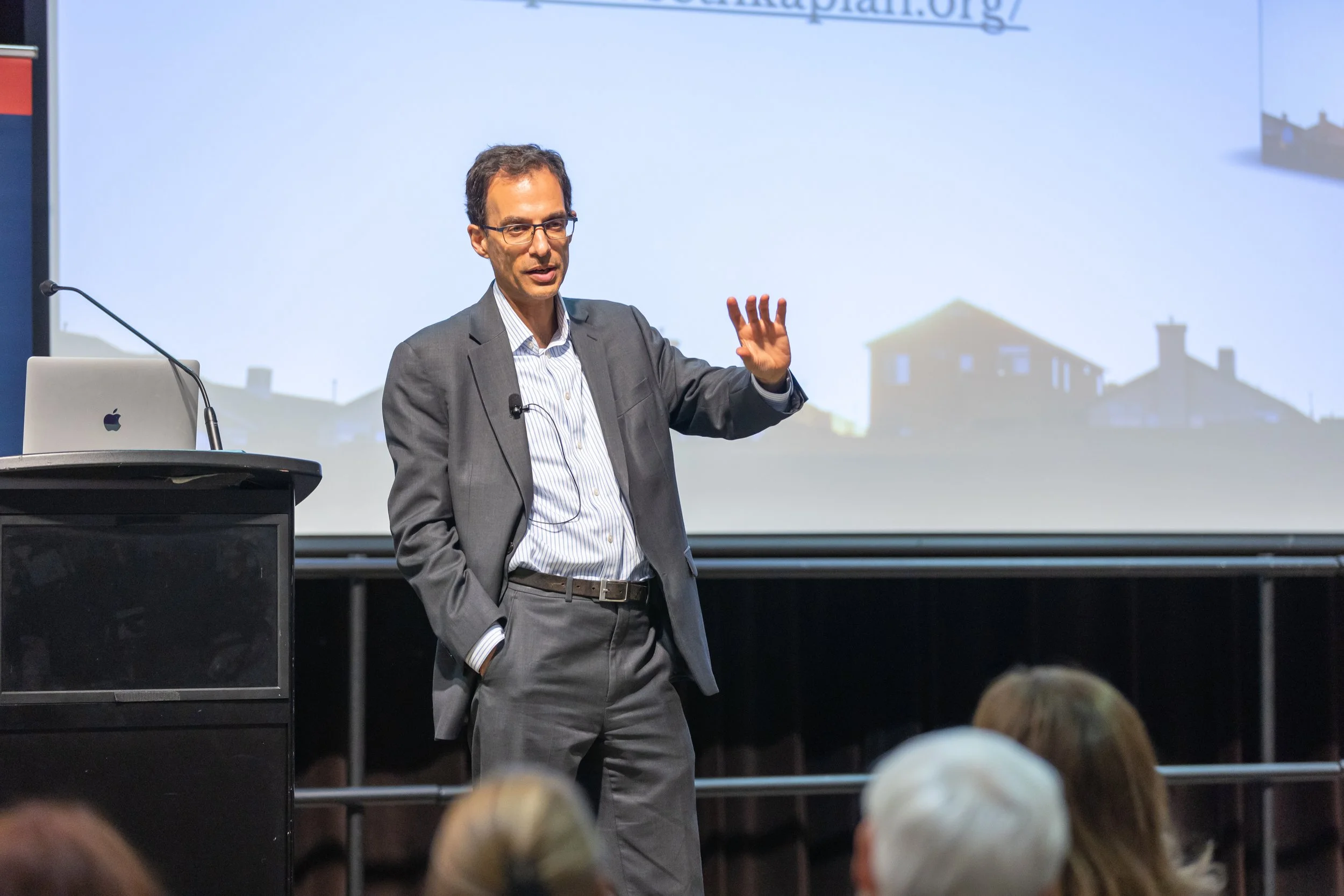
Dr Seth Kaplan delivering the Bahá’í Chair for World Peace Annual Lecture 2025
Professor Kaplan certainly fits the bill. A veteran of such knotty challenges as war and political upheaval in Somalia, Yemen, Sri Lanka, Azerbaijan and others, he has formed a unique political philosophy and sociological approach that seeks to build communal unity and a spirit of bought-in participation. In a career toiling on the frontlines of conflict in more than 70 countries and as the author of 4 books and numerous articles, studies, and reports, Dr. Kaplan is well placed to advise on the best ways to induce and sustain societal cohesion and development.
And his message was a hopeful one. Change can happen, he insisted. Not only that, but change is happening, now. And there is a playbook that exists, he argued, that anyone, rich or poor or otherwise, can follow. A playbook that emphasizes, place, person, community, civic and social participation, and engagement on a personal level. As a framework, Dr. Kaplan described the use of Zip Codes, population-based organizers for the postal service, as a kind of exemplar of communal possibility and focus.
Professor Kaplan’s call to community echoed other forms of invite, across the horizon of political interest, intellectual foment, and ideological inclination. In some ways his rich and dignified treatise felt tied to older, 19th and 20th century ideals and movements, while also mirroring what Roger Scruton, by way of Edmund Burke, called “little platoons”.
Scruton described little platoons, a slightly smaller version of Professor Kaplan’s Zip Codes, as “places where traditions form” that contain “adaptations of the community rather than of the individual organism.” Dr. Kaplan describes these “adaptations” as opportunities to work side-by-side in pursuit of shared goals and argued (based on compelling research) that it is indeed these pursuits which allow individuals and communities to overcome personal differences.
Dr. Kaplan insisted that the solutions to civil and political conflict must first happen locally. And in an anecdote about working in declining communities in Detroit, he reminded the gathered audience that good intentions are not enough – buy-in, listening, and getting to know members of the community must take place before the “real work” can begin. Indeed, Professor Kaplan argued that it is this – the personal process of knowing one’s neighbors and community over time – that is the real work.
Though the world’s problems are complex, and a nation’s challenges are complicated, and a community’s issues are frustrating, Dr. Kaplan insisted that the pathways to clarity and understanding begin house by house, neighbor by neighbor, community by community. In his telling, small civic undertakings and communal gatherings matter deeply to the overall health of individuals and communities worldwide.
And just so that we are without excuse, Professor Kaplan reminded the audience that vast tribal and religious differences have not existed for thousands of years in this country, nor have they created decades-long wars. Our similarities, he suggested, are much more important than our differences. Having toiled in some of the most vexed and challenging communities in the world, Professor Kaplan encouraged his American audiences to take heart – “No, it’s not worse here,” he insisted, adjuring the audience to maintain a broad perspective of possibility and not give into cassandras about unavoidable societal decline. Rather, it was critical to not only view the possibilities of restored communities as a nearby goal, but to actively participate in such works. Though he did not say it explicitly, his overall message seemed to be ‘direct involvement and engagement often leaves one with little time to criticize’. For Kaplan, that involvement takes place, or at least begins, at the neighbor’s door, two or three streets over, at the nearby school, at the local church, where the needs – and the opportunities – are many.
As mentioned, the Baha’i Chair’s Annual Lecture tackles head on seemingly deep and imperturbable challenges to the nation’s, and the world’s pathways to peace. Previous Annual Lecturers have addressed climate change, technology, racism, sexism, and world government. Dr. Kaplan set as his predicate a widely and deeply felt malaise about the possibilities of world improvement. He referenced Robert Putnam’s defining sociological work, Bowling Alone, which captures that all too modern affliction – the sense of an atomized society, and the late spoiling of a totemic individualism deeply unsatisfactory to the human soul. Professor Kaplan also cited former Surgeon General Vivek Murthy’s report that described loneliness as a public health epidemic. Indeed, statistics in America and throughout the developed world tell a grim tale. Increasing rates of suicide and deaths of despair. A sense of severe social disconnection. The notion that whose with whom we disagree with are our enemies.
And yet, Dr. Kaplan remained bullish on our individual ability to make incremental changes – changes that that in turn shape communities, societies, nations, the world. But his bullishness also embraced a clear-headedness about what would not work.
The commodification of community into a vector for corporations to earn money. That would not work. The onlining of community. That would not stir the deepest reaches of our social humanity. In his telling, local communities are corporeal, of the body, and refer to a chosen, conscripted living, with the lively social jostling providing opportunities for healing, care, concern, and growth. Such communities are not relics of ‘the good old days’, nor are they abstracted ideals of public good, but reflect distinct human needs to connect people to places and places to people. For Professor Kaplan, these needs touch on things vitally human, foundational, soulish. Such needs, he reasoned, deserve a robust infrastructure.
Reminding the audience that the observances of the great French thinker de Toqueville are still true – that America possessed a never-before-seen genius for building civic and community life – Kaplan delivered marching orders to everyone who attended. Do you know your neighbors, he asked. Do you know what’s happening in your community. There are places, and people, to serve. He advised the audience that it is along such parallel lines of purpose and place that smaller disagreements – and even larger ones – can be hashed out and even passed over. Meeting for the sole purpose of debating such differences is not helpful he noted, but instead men and women should look for opportunities to join a kind of shared congress of effort, one that benefits all those living in a particular community, including you.
You can view the video of the lecture on youtube here.
About the Author:
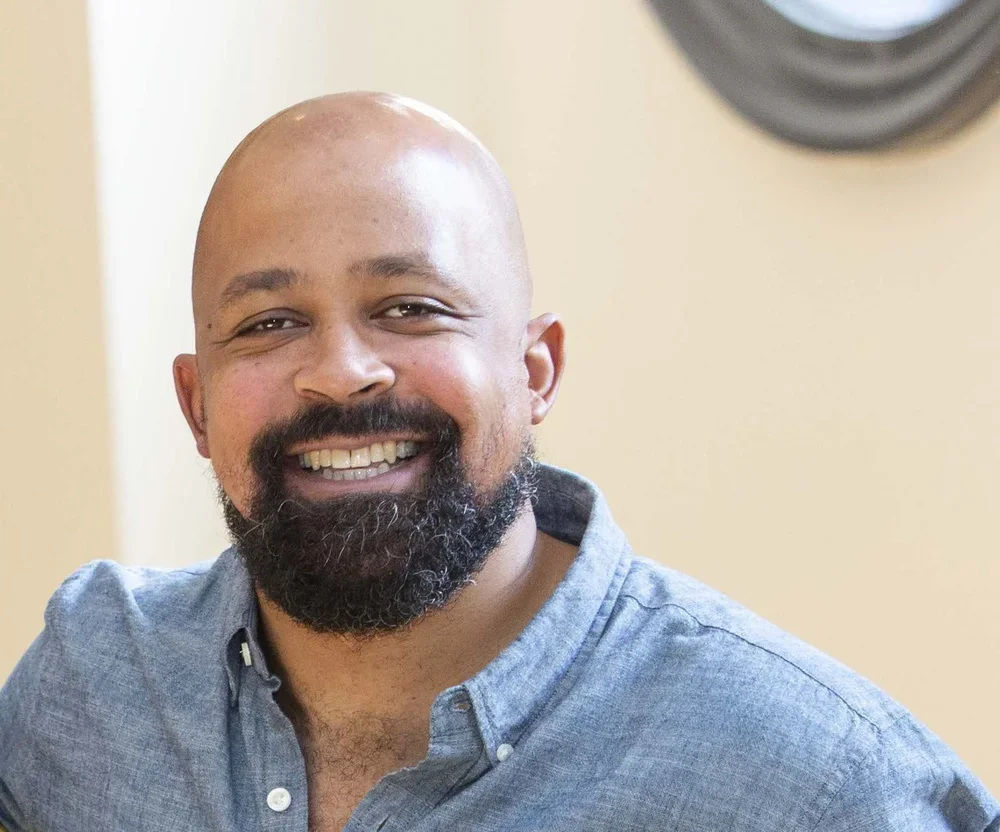
Malik Wilson is a Faculty Fellow at the Bahai Chair for World Peace at the University of Maryland. He works closely with Dr. Mahmoudi in matters relating to editorial concerns – publications, speeches, and publishing.